California's Digital Driver's License Quietly Endorsed the Thing We Built RedactID On
California's mDL pilot shares only the field a verifier asks for, not your whole license. That principle, selective disclosure, is now official state policy. Here is how to apply it to every document you still send as a file.
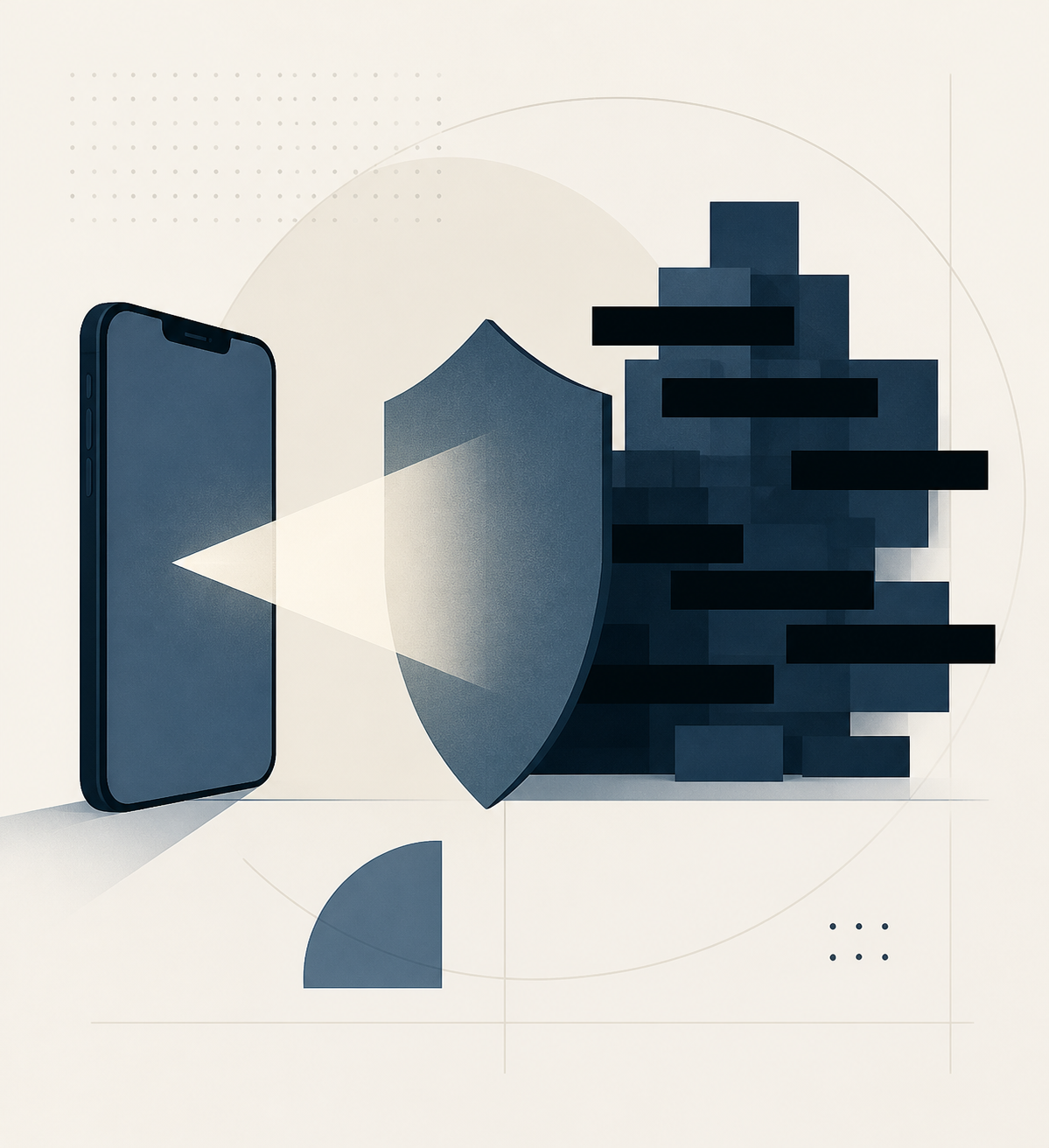
Buried in a run of local coverage this month was a story that sounds like a DMV convenience update and is actually a philosophical shift. California is expanding its free mobile driver's license program, and the way that credential works quietly makes an argument this company has been making since day one.
Here is the mechanic that matters. When you present a mobile driver's license, you are not handing over your license. You are answering a question. The California DMV describes an ID in Apple Wallet as presenting only the information needed for the interaction, with the request shown to you before you approve it with Face ID or Touch ID. Nothing is released until you authorize that specific release. You never hand your phone to anyone.
Compare that to the physical card in your wallet. When a bouncer checks whether you are over 21, they see your full name, your date of birth, your home address, your license number, your height, and your signature. They needed one bit of information and they got fifteen. That is not a security failure, it is just how a printed rectangle works. Everything on it is visible the moment it leaves your hand.
The industry term for the better version is selective disclosure, and California just made it default behavior for the most commonly requested ID document in the country.
Why a redaction company cares about this
Because it settles an argument.
For years the instinct when someone redacted fields on a document before sending it was mild suspicion. Why are you blacking things out? What are you hiding? There was a faint implication that a normal person hands over the whole document and only someone with something to hide does otherwise.
A state government just built the opposite assumption into its official ID. The default is now that a verifier receives the minimum, and anything beyond that requires a reason and your explicit approval. Sharing less is not evasive. It is the design goal.
That principle does not stop at the DMV. It applies to the bank statement your landlord wants, the pay stub HR asked for, the utility bill a bank wants for proof of address. In every one of those exchanges someone needs one fact and is being handed a document containing thirty.
The gap the mDL does not close
Now the uncomfortable part, and the reason this is not a story about how the problem is solved.
The mDL works in a very specific situation: a live, in-person verifier with a compatible reader at a participating location. California's own FAQ scopes it to identity and age verification at select locations and airports. TSA says Digital ID is accepted at more than 250 airports, and adds that participation is optional and all passengers must still carry an acceptable compliant physical ID. The DMV is equally direct that under the pilot, the mDL does not replace your physical card.
So the elegant, privacy-preserving, minimum-disclosure credential covers the airport line and the occasional participating retailer.
It does not cover:
- The rental application portal that wants a photo of your license uploaded as a JPG
- The car dealership that photocopies your license and keeps it in a folder
- The bank that asks you to email a scan for account verification
- The new employer's onboarding system that wants your ID and a voided check
- The gym, the phone carrier, the storage unit, the notary
Every one of those is a file transfer, not a verification event. Once that image lands in their inbox or their document management system, selective disclosure is over. They have all of it, permanently, on infrastructure you will never see and cannot audit. When that vendor is breached in three years, your license number goes with it.
This is worth sitting with, because it is the actual shape of the risk. The moments where identity verification is well designed are the moments where nothing is stored. The moments where things get stored are exactly the moments where verification is designed worst, as an email attachment.
Doing selective disclosure by hand
Until every institution supports a proper credential exchange, the manual version of selective disclosure is redaction. You decide what the recipient actually needs and you permanently remove the rest before the file leaves your device.
The question to ask before any document upload is the one the mDL asks on your behalf: what is this specific party verifying?
- A landlord verifying income needs your name, employer, and pay figures. Not your SSN or your direct deposit account number.
- A company verifying your address needs your name and address on a utility bill. Not your account number with the utility.
- Someone verifying your identity from a license needs your name, photo, and expiry. Often not your license number or your home address.
- A lender verifying assets needs balances and account holder name. Not the full account number or every transaction.
Then remove everything else. Properly, so it is gone from the file rather than covered with a black box that can be dragged away or selected as text underneath. A rectangle drawn in an image editor or a PDF viewer's markup tool frequently leaves the original data intact in the file. Flatten the export, reopen it, and try to select the hidden text. If nothing comes out, it worked.
RedactID does this in your browser. The file never uploads, never touches a server, and is never stored, which is the only version of a redaction tool that makes sense. Requiring an upload to a stranger's server to protect a document from strangers' servers defeats the purpose. There is a free daily allowance, with credit packs and Pro for heavier use.
If you want the field by field breakdown for specific documents, we have walkthroughs for a bank statement, a pay stub, and an ID or driver's license.
The takeaway
The mDL is genuinely good news and worth enrolling in if you are in California. It is free, and it means one of your most sensitive documents stops being overshared in at least some contexts.
But treat it as a statement of principle rather than a fix. The state has now certified that showing less is the correct behavior. The overwhelming majority of times you are asked for a document, no one has built you the elegant version, and you are the one who has to enforce it.
Selective disclosure at the airport is progress. Selective disclosure on every file you send is the part still left to you.
Sources: California DMV, mDL Q&A and TSA, Digital ID. Related: Redact documents online, redact an ID online, redact a bank statement, redact a pay stub.Ready to try it? See pricing and start free.
Do it now, free
Everything runs in your browser. Your file is never uploaded.
Ready to Protect Your Privacy?
RedactID lets you redact sensitive information from documents without uploading them — everything is processed on your device.